01
Speed & Accuracy
Regular Abacus practice helps children become more fluent with calculation steps and number patterns.
Abacus learning combines hands-on calculation, visualisation and regular mental arithmetic practice. Over time, children can become more comfortable with numbers and more independent in calculation.
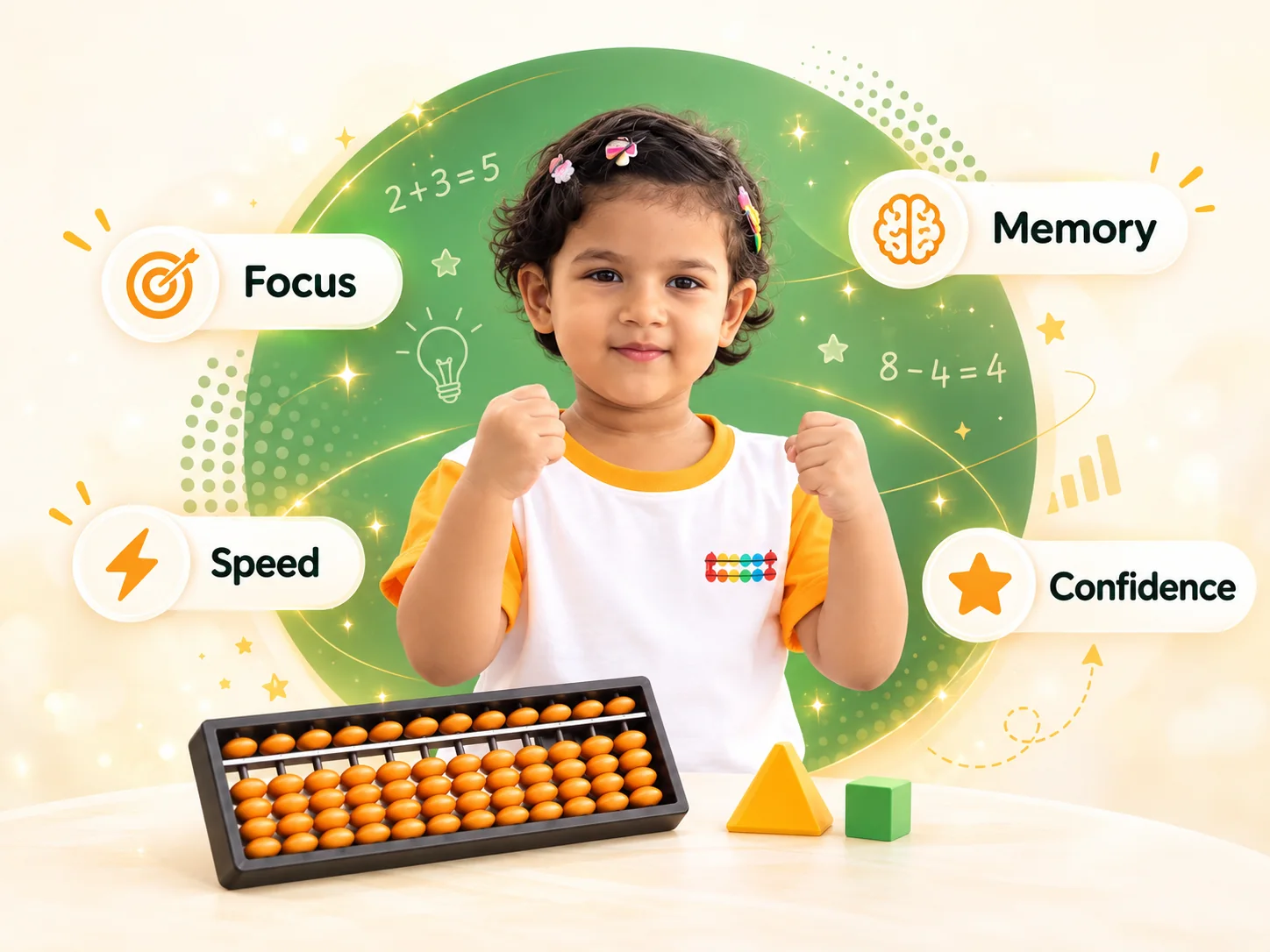
Children begin by moving real beads, then gradually learn to visualise those bead positions and calculate with less dependence on the physical tool.
Read the What Is an Abacus guide →These are learning outcomes Abacus training is designed to support. Individual results vary with age, attendance, practice and learning pace.
Regular Abacus practice helps children become more fluent with calculation steps and number patterns.
Following bead movements and teacher instructions gives children repeated practice in sustained attention.
Remembering bead positions and calculation sequences gives working memory frequent practice.
Learners gradually build the ability to picture an Abacus and imagine bead movement without holding the tool.
Structured practice and visible progress can help children feel more comfortable when working with numbers.
Abacus calculation breaks arithmetic into a consistent sequence of visual and numerical steps.
The long-term learning goal is to calculate mentally with less dependence on the physical Abacus.
Short, regular practice encourages consistency — an important habit for progressing through the curriculum.
The value comes from repetition and progression rather than from a single trick or shortcut.
The learner follows the teacher, numbers and bead positions carefully.
With practice, bead positions become easier to picture mentally.
The child applies learned methods and updates the imagined bead pattern step by step.
The final mental image is translated back into a numerical answer.
Research has explored links between Abacus training and areas such as working memory, attention and numerical processing. Findings vary by study design, learner group and training intensity, so we avoid presenting these effects as guaranteed outcomes for every child.
Live teacher-led sessions from home with structured Abacus practice and access to Mastermind digital learning tools.
Learn in person at an available Mastermind Abacus Bangladesh branch.
Find a Branch →