Arithmetic processing
Number rules, learned procedures and verbal or symbolic calculation contribute to the task.
Mental-Abacus training has been studied through behavioural tests and brain imaging. The strongest evidence is around arithmetic fluency, visuospatial working memory and the visual strategies used during mental calculation.
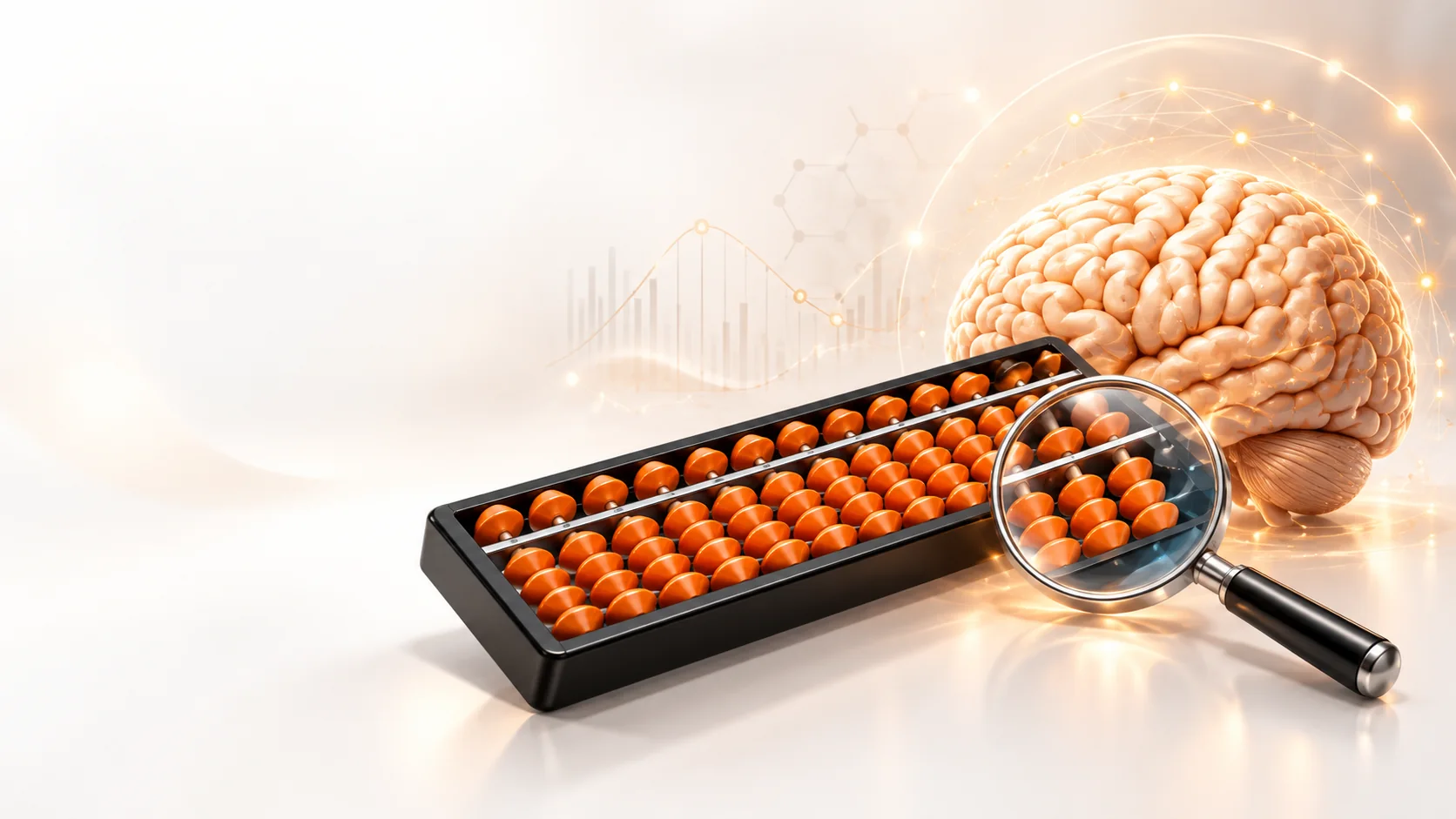
Research supports a cautious yes for specific skills. Mental-Abacus training is associated with stronger arithmetic performance and visuospatial working-memory skills in several studies, and neuroimaging shows that trained calculation uses brain networks involved in visual and spatial processing.
The popular “left brain vs right brain” picture is an oversimplification. In real brains, calculation and visualisation depend on distributed, interacting networks. Mental-Abacus training is interesting because it adds a strong visuospatial strategy to arithmetic.
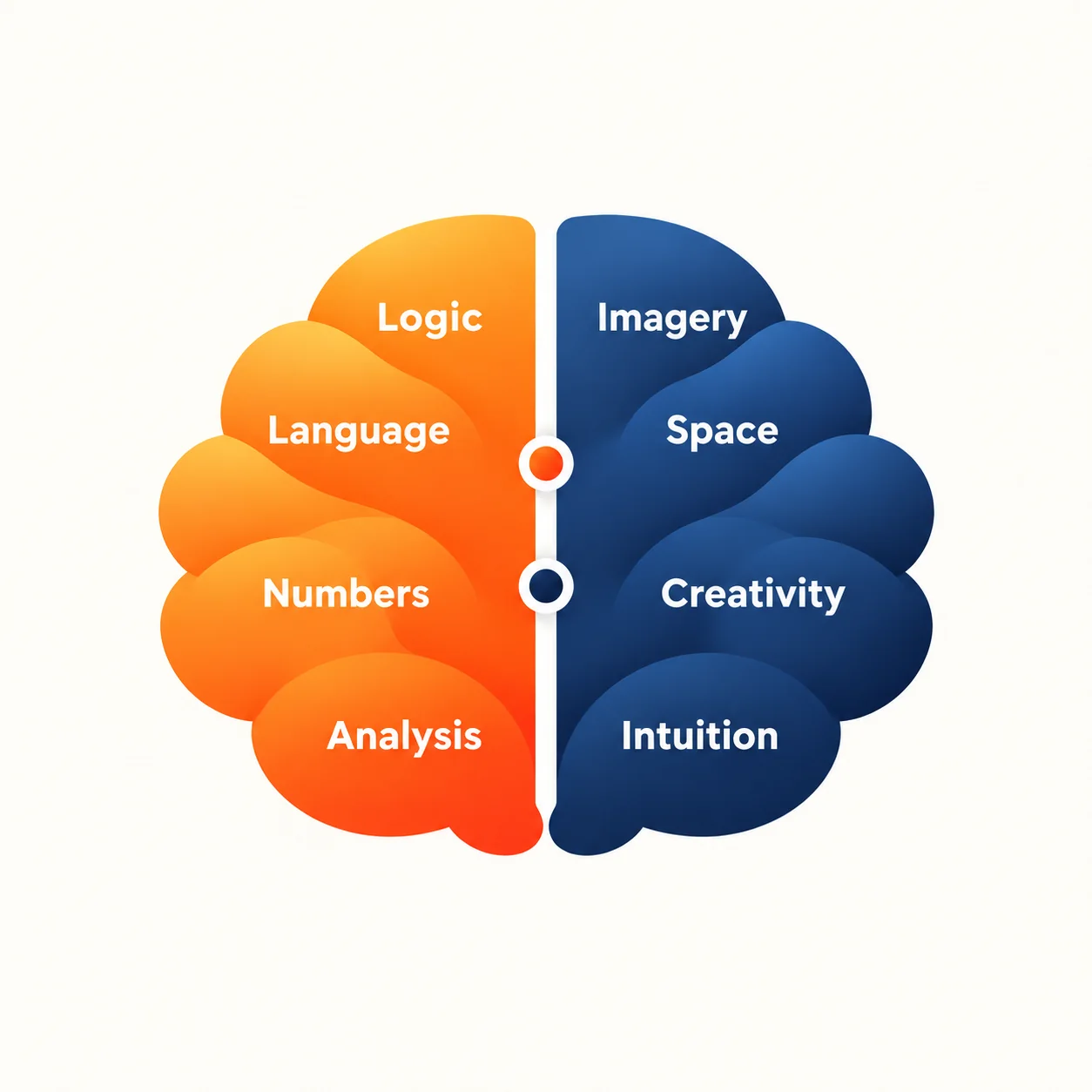 Illustrative concept — not a literal map of brain function.
Number rules, learned procedures and verbal or symbolic calculation contribute to the task.
Skilled learners can picture an Abacus and manipulate imagined bead positions while calculating.
Research points to coordinated frontal, parietal and occipital regions rather than a simple one-hemisphere explanation.
A plain-language summary of peer-reviewed findings — including limitations, not just positive headlines.
A 2020 neuroscience review reports that trained mental-abacus calculation relies heavily on frontal-parietal visuospatial networks, while conventional calculation more often recruits language-related networks.
Frontiers in Neuroscience, 2020 ↗In a five-school-year study, children receiving abacus-based mental-calculation training outperformed controls on arithmetic and visuospatial working-memory tasks, although the authors described the broader transfer effects as limited.
Journal of Neuroscience, 2019 ↗A 2025 quasi-experimental study of 190 schoolchildren reported significant improvement in the trained group on measures related to visuospatial working memory after four months, with small effect sizes and a call for longer-term research.
PLOS ONE, 2025 ↗Abacus training is not a proven shortcut to higher general intelligence, and no responsible study can promise the same cognitive gain for every child. The 2020 review explicitly calls for caution when generalising results, and the 2025 PLOS ONE study reported small effect sizes and recommended longitudinal research.
Her published work examined how abacus learning affected calculation performance and how mental-abacus representations relate to digit memory. Findings support strong calculation fluency, while also showing that transfer to other methods is not automatic.
Read source ↗Classic developmental studies helped establish the idea that skilled mental-abacus users represent and manipulate numbers visually rather than relying only on verbal calculation strategies.
Read source ↗Later imaging work moved the field beyond observation, linking mental-abacus expertise and training with functional and structural differences in frontal, parietal and occipital-temporal regions.
Read source ↗Try a guided session before deciding whether the programme fits your child.